FARADAY’S LAW
Michael Faraday use a magnetic
field to produce an electric current. He then discovered two ways to produce an
induced emf.
field to produce an electric current. He then discovered two ways to produce an
induced emf.
- One is to move a conductor in a
magnetic field - Second is does not involve
movement of the conductor, but changing magnetic field induces an emf in
conductor even if the conductor is stationary.
Faraday’s law says
that the magnitude of the induced emf around a loop is equal to the rate of
change of the magnetic flux through the loop.

that the magnitude of the induced emf around a loop is equal to the rate of
change of the magnetic flux through the loop.


Lenz’s law is the
direction of the induced current in a loop always opposes the change in
magnetic flux that induces the current
direction of the induced current in a loop always opposes the change in
magnetic flux that induces the current
- How to apply Lenz’s Law:
- Look at the direction of the magnetic field
produced by induced current. - Example;
o
If the flux is incrasing through a coil, the
current produced by the induced current will generate flux that tends to cancel
the increasing flux
If the flux is incrasing through a coil, the
current produced by the induced current will generate flux that tends to cancel
the increasing flux
o
OR if the flux decreasing through the coil, the
current will produce a flux that tends to restore the increasing flux.
OR if the flux decreasing through the coil, the
current will produce a flux that tends to restore the increasing flux.

TRANSFORMER
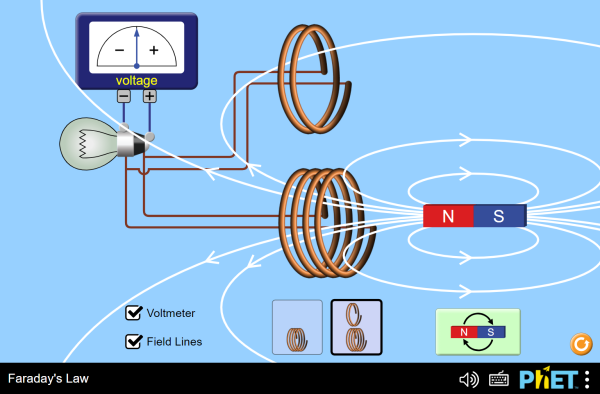
FARADAY SIMULATION (INTERACTIVE)